Notes
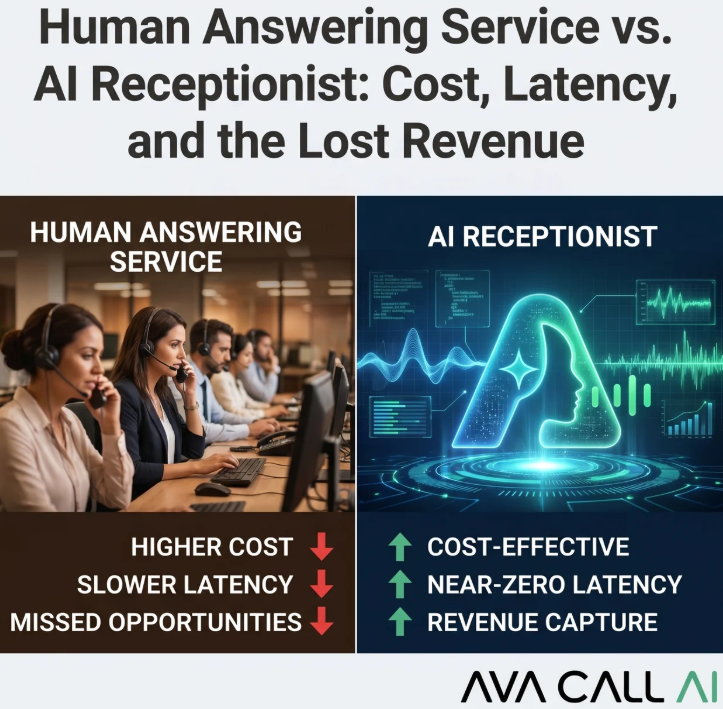
- A human answering service costs £150–£350/month to take a message. An AI receptionist at the same price point books the appointment in real time.
- The "called twice, no answer" Google review is a measurable revenue event — it's a lost patient or job permanently recorded in public.
- AI voice agents built on modern infrastructure hold response latency below 1.2 seconds. Human operators average 3–5 seconds navigating a CRM — enough for a caller to assume no one's there.
- The #1 reason AI receptionists fail at small businesses has nothing to do with the AI. It's that the business has no structured SOP to give it.
- Ava Call AI converts your existing business knowledge into a live, booking-capable agent — in days, not months.
There's a review sitting on a competitor's Google profile right now that reads: "Called twice, no answer."
That's not a complaint. That's a receipt.
It's a record of a real person — a patient who needed a dentist, a homeowner with a burst pipe, a mother looking to book an urgent appointment — who tried twice, got nothing, and booked somewhere else. And now that failure is public, permanent, and indexed by Google.
The question isn't whether your business can afford an AI receptionist. It's whether it can afford to keep generating those receipts.
The Lost Revenue Receipt: What a Missed Call Actually Costs
A missed call at a private dental practice isn't a missed call. It's a missed new patient worth £2,000–£4,000 in lifetime value across checkups, hygiene appointments, and treatment. At a London emergency plumber, it's a job worth £150–£600 that went to whoever answered first.
The calculation that most business owners run is wrong. They think: "I missed one call, cost me one job." The real model looks like this:
Missed call volume × average job value × loss rate = the number nobody wants to see.
A plumbing business missing 15 calls a month at £200 average job value isn't losing £3,000. It's losing £3,000 in booked revenue plus whatever those callers tell other people, plus the Google reviews they leave, plus the SEO damage those reviews do to local rankings.
Human answering services have existed as the solution to this problem for decades. The honest version of what they provide: a person answers, takes a name and number, sends you a text or email, and moves on. The lead sits warm. You call back when you can — which is often hours later, after they've already booked with someone else.
Message taking is not pipeline execution. And the gap between those two things is where revenue disappears.
Message Taking vs. Pipeline Execution: The Core Difference
The fundamental divide between a legacy human answering service and a properly built AI receptionist is this transition: from passive message logging to active pipeline execution.
Human call centres optimise for handle time — getting the caller off the phone quickly to move to the next call in the queue. They're not incentivised to book, qualify, or convert. Their job ends when the message is logged.
An AI phone agent optimises for state resolution. By tying an LLM's semantic reasoning to a deterministic API workflow, it can verify service zone eligibility, query live scheduling databases, and push structured data directly into a CRM during the call — all while maintaining a sub-1.2-second P99 latency threshold that eliminates the dead-air pauses associated with legacy IVR systems.
In practical terms: the caller asks to book. The AI checks the calendar. If a slot is available, it confirms the booking, captures the contact details, and fires a CRM entry — before the call ends. No callback required. No warm lead going cold overnight.
At £150–£350/month, a human answering service delivers a message. At a comparable price point, Ava Call AI delivers a booked appointment.
The P99 Latency Problem (Why Callers Hang Up on Automated Systems)
The most common complaint about automated phone systems isn't the voice. It's the pause.
That 2–3 second gap after a caller finishes speaking, before the system responds, is enough for most people to assume the line is broken. Older callers especially — the demographic that makes up a significant share of private dental patients and homeowner emergency enquiries — interpret silence as a dead line and hang up.
P99 first-token latency is the metric that governs this. It measures the absolute maximum time a voice AI system takes to begin responding after a caller stops speaking — specifically the 99th percentile response time, meaning the worst-case scenario across all calls.
For voice channels, the threshold is 1.2 seconds. Above that, call abandonment rates climb. Below it, callers don't notice they're talking to an AI at all — the conversational rhythm feels natural.
Human operators navigating a CRM during a call average 3–5 seconds between a caller's question and a useful answer. They're looking up availability, finding the right script, typing notes. That lag is invisible to us because we've normalised it. On a phone line, it's the difference between a booked appointment and a hang-up.
Ava is built on voice infrastructure optimised specifically for sub-1.2-second response initiation. The result: calls that feel like talking to an attentive receptionist, not a confused automated system.
The SOP Translation Layer: Why AI Receptionists Actually Fail
Here's what nobody in this industry will tell you.
The AI isn't the variable. Your process documentation is.
The most common reason a small business deploys an AI receptionist and gets bad results is that their internal processes were never written down in the first place. The knowledge lives in the owner's head — service zones they know instinctively, pricing ranges they quote by feel, the categories of jobs they won't take. None of it is documented. So when the AI needs to reference it, there's nothing to reference.
A human receptionist filling in for a week would have the same problem. They'd either guess, or call the owner every five minutes. The AI just fails silently instead.
The fix isn't complicated — but it requires doing the work.
What a structured SOP looks like before AI deployment:
Messy version (what most businesses have): "We cover South London, usually — depends on the job. Prices vary. Don't book anything too far."
Structured version (what the AI needs):
- Service zones: SW1–SW19, SE1–SE28, CR0–CR9. Decline all other postcodes.
- Pricing: Standard call-out £85 (Mon–Fri, 8am–6pm). Emergency surcharge £45 applies after 6pm and weekends.
- Job categories: Blocked drains, boiler repairs, leak fixes — yes. Full bathroom installations — not via phone booking, refer to email enquiry.
- Escalation trigger: Any mention of flooding, gas smell, or structural damage — immediate live transfer to owner's mobile.
The second version isn't complicated to write. If you can write a clear enough process document for a temporary worker to follow on day one, you have everything needed to deploy a working AI agent.
At Ava Call AI, the onboarding process extracts this structured data through a business intelligence intake — questions designed to surface the implicit rules that live in a founder's head and convert them into the logic the AI needs to operate reliably. Most clients go from intake to live agent in under a week.
The Midnight Burst-Pipe Stress Test
It's 11:47pm. A homeowner in Wandsworth has water coming through their kitchen ceiling. They've found your number on Google, and they're calling in a state of controlled panic.
What happens with a human answering service:
The on-call operator picks up. They take the name, the address, and a brief description of the problem. They send a message to an email address or a pager. The message sits. You might see it at 7am. The homeowner, not hearing back, called two other plumbers twenty minutes after the first call. One of them answered. They took the job.
What happens with Ava:
The call connects in under two rings. The AI identifies the urgency signal within the caller's first sentence — "it's leaking through the ceiling" triggers an emergency-category classification in the deterministic layer.
The agent confirms the address. A background webhook checks the CRM for the on-call status — whether an engineer is available and within range. If coverage is confirmed, the agent locks in an emergency visit, quotes the call-out fee, captures the contact number, and fires a CRM entry and SMS notification to the engineer — all within the same call, before the caller hangs up.
If no engineer is available, the call routes to the owner's mobile with a warm transfer: "I have a customer on the line with an emergency leak in Wandsworth — transferring you now."
No message sitting in an inbox. No lead going cold. No job lost to whoever answered second.
The homeowner called once. They got a resolution. That's the operational difference.
The Real Cost Comparison
| Human Answering Service | Ava Call AI (Growth Tier) | |
|---|---|---|
| Monthly cost | £150–£350 | £697 |
| Available hours | Business hours (mostly) | 24/7/365 |
| Books appointments | No — takes messages | Yes — live calendar integration |
| CRM updates | Manual, delayed | Real-time, automated |
| Response latency | 3–5s (CRM navigation) | Sub-1.2s (P99 threshold) |
| Emergency routing | Message relay, delayed | Instant live transfer |
| Google review risk | High (missed calls logged publicly) | Low (every call gets a resolution) |
| Setup time | Same day | 3–5 days (structured intake) |
The pricing comparison looks unfavourable at first glance. It isn't, once you run the revenue math.
A private dental practice on a human answering service that misses three new patient enquiries a month — each worth £2,000+ in lifetime value — is losing £6,000+ monthly to protect a £300 monthly spend. An AI receptionist that converts one of those three enquiries pays for itself four times over.
The question isn't whether you can afford to upgrade. It's how much the current setup has already cost you.
What Makes Ava Different
Most AI receptionist providers sell you a tool. You're responsible for making it work.
We don't operate that way.
Every Ava deployment includes a structured business intelligence intake, knowledge base build, deterministic call logic configured to your rules, and a go-live process that doesn't end until the system is handling real calls correctly.
And we're building toward something larger. Ava Call AI's roadmap is to become the most capable AI front office system for premium local businesses in the world — not just answering calls, but managing inbound pipelines, outbound sales & follow-up, reactivation sequences, review generation, and AI-powered content that keeps clients visible in search. The businesses that deploy Ava now are getting in at the foundation of something that compounds. That's a deliberate choice, not a sales line.
FAQ
How much does a human answering service cost in the UK?
Human answering services in the UK typically cost between £100 and £400 per month depending on call volume and hours covered. Most services at this price point take messages only — they do not book appointments, update CRMs, or execute follow-up actions.
What is P99 first-token latency and why does it matter for AI voice agents?
P99 first-token latency is the maximum time a voice AI system takes to begin speaking after a caller stops — measured at the 99th percentile to capture worst-case response times. For voice channels, anything above 1.2 seconds causes callers to assume the line is dead and hang up. Well-built AI voice systems like Ava operate below this threshold consistently.
How long does it take to switch from a human answering service to an AI receptionist?
With Ava Call AI, the structured onboarding process typically takes 3 to 5 working days from business intelligence intake to a live, tested agent. The setup time depends on how clearly the business can articulate its pricing, service zones, booking criteria, and escalation rules.
Will an AI receptionist work for emergency trades businesses?
Yes, and it's one of the highest-value use cases. emergency trades businesses — plumbers, electricians, locksmiths — take a disproportionate share of their revenue from out-of-hours calls that human services can't action in real time. An AI agent that can verify coverage, lock in emergency slots, and route live transfers handles exactly the scenarios that generate the most revenue and the most risk.
What happens to calls that the AI can't handle?
A properly configured AI receptionist never leaves a caller stranded. Ava uses a three-tier fallback: clarifying question, message capture with confirmed callback, or live transfer — triggered by urgency signals in the conversation. No call ends without a resolution of some kind.
How is an AI receptionist different from an IVR phone menu?
An IVR (Interactive Voice Response) system is a menu tree — "press 1 for appointments, press 2 for billing." It requires callers to navigate rigid options and fails the moment someone says something unexpected. An AI receptionist handles natural language conversation, adapts to what the caller actually says, and executes real actions (booking, transferring, logging) rather than routing to a department.